This editorial by steering committee member Karin Kirk was published in papers across Montana, in print and online.
I was happy to see that NorthWestern Energy replied to my previous column that showed how data centers are raising electricity prices for households. I’m not surprised that they responded, because they probably realize that data centers are really unpopular, especially in Montana.
NorthWestern Energy’s business plan depends on data centers gobbling up electricity. They’re working on plans to more than double their electricity demand in Montana thanks to three new data centers, with the possibility of 11 more in development. Without data centers, NorthWestern Energy’s newly acquired portions of the Colstrip power plant won’t have much of a purpose. They need to find a willing customer for Colstrip’s expensive and polluting electricity, and apparently tech companies don’t care about pollution and probably don’t care that much about price, especially if they can offload that burden onto you and me.
In his response to me, Jason Merkel, NorthWestern Energy’s VP of Distribution, agreed with my main points that we need transparency and clear guardrails for data center development. Great! Now let’s compare his statements to NorthWestern Energy’s actual transparency on data centers.
NorthWestern Energy’s first plan to connect data centers to the grid was simply to do it, without a public process or approval from the Public Service Commission. Nice try! The PSC didn’t agree with NorthWestern Energy’s “creative” attempts to circumvent state law.
Next, NorthWestern Energy said they would release a plan that sets up the specific terms, conditions, and price structure for data centers. This is called a large-load tariff. The company said they would release that by December of last year.
Not only has NorthWestern Energy still not released its large-load tariff, but now they’ve delayed it until June.
The crux of Merkel’s response is, “Trust us, it’s gonna be great.” He sings the praises of a plan that must be so fabulous that they won’t even show it to us. That seems like a weird way to demonstrate transparency.
But it gets worse.
The reason NorthWestern Energy won’t release their price structure is because first they want to get farther down the path of firming up their plans with data center developers. Once they have a solid deal in hand, then they’ll do the big reveal, and show us all what they’ve come up with.
There are a bunch of problems with NorthWestern Energy’s approach. First, it’s disingenuous. They said they’d release their large-load tariff in December and now they’re delaying by six months. But even more worrisome is that the farther they get in their negotiations with data centers, the harder it is for the public to know what they’re up to, and to participate in the process.
Merkel made repeated statements that don’t match NorthWestern Energy’s actions. “There will be no hidden discounts.” “Rates for large-load customers are set in a public process.” Rates “are not privately negotiated.”
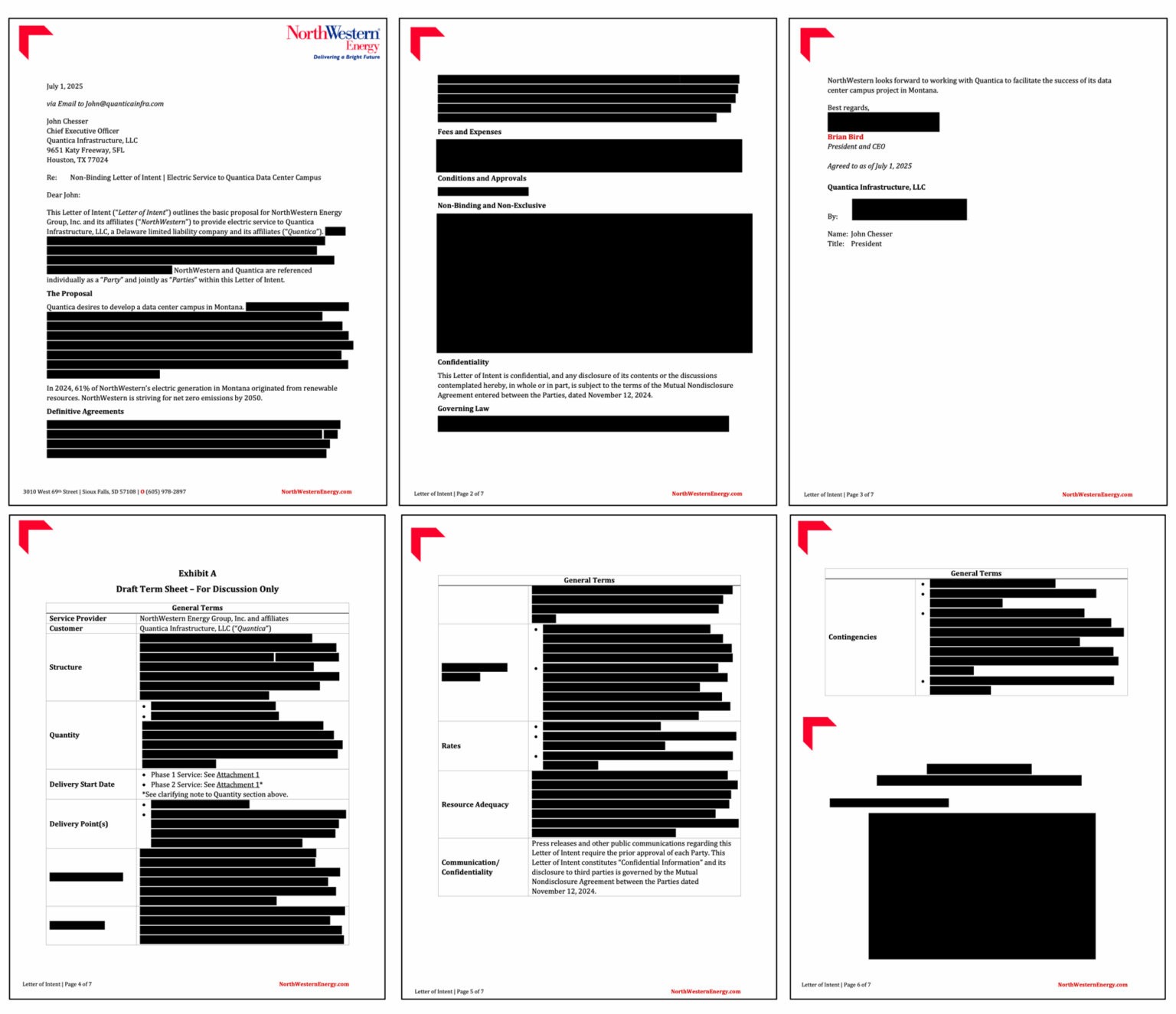
But here’s the reality: The electricity agreements between NorthWestern Energy and the data centers are entirely redacted. All the public gets to see is page after page of black rectangles. Even worse, the Public Service Commission is allowing NorthWestern Energy to keep these documents secret. That’s the opposite of a public process. It is entirely hidden from us, and of course it’s being privately negotiated, otherwise we’d be able to see the details.
It’s amazing how much can be revealed by a blacked-out document. It shows that NorthWestern Energy is not being honest with us, and that the Public Service Commission would rather protect NorthWestern Energy than allow the public to know what’s going on.
For a company that promises to keep the lights on, NorthWestern Energy is working awfully hard to keep us in the dark.
Karin Kirk is a geologist and science journalist specializing in energy and climate. She sits on the steering committee of Montanans for Affordable Energy.